Monday, 11 July 2011

Stephen Sauvestre: The forgotten architect of the Eiffel Tower

Ask most people to name the architect of the Eiffel Tower, and more likely than not they will reply that it was Gustave Eiffel himself. However, whilst Eiffel and his team were behind the initial project and were the engineers that planned and built the tower, it was actually an architect called Stephen Sauvestre who gave the tower much of its distinct look.

Although Sauvestre’s name is rarely mentioned in connection with Paris’s iconic tower, it is one that can still be found on the walls of the city, particularly in the Plaine Monceau in the 17th arrondissement. This was where Sauvestre lived and worked, helping to build a whole new quarter of the city in eclectic styles that would influence the Art Nouveau movement.


A selection of features on the facades of some of the houses designed by Sauvestre.

Stephen Sauvestre was born in 1847, and was one of the first graduates of the Ecole spéciale d'architecture, a new school set up to separate this discipline from the world of the Beaux-Arts. Students learned about modern techniques involving metal structures, and a little later reinforced concrete, and were encouraged to work on useful municipal projects such as schools and hospitals.

A towering friendship with Gustave Eiffel

After working on a few small scale projects, Sauvestre's first important project in Paris was already a combined effort with Gustave Eiffel. The two men worked together on the design of the Pavillon de Gaz for the Exposition Universelle in Paris in 1878, a collaboration that would mirror their much more famous joint creation a decade later.

The tower project began in 1884, when two of Eiffel's employees, Maurice Koechlin and Emile Nouguier, proposed a project for a 300m high tower to mark the 1889 universal exhibition. The French authorities were looking for emblamatic and ambitious creations to help detract from national and international difficulties, but Gustave Eiffel knew that this creation would struggle without more of an aesthetic touch.

The Eiffel Tower project team. Stephen Sauvestre is on the left, and Gustave Eiffel is in the centre.

Eiffel had already seen the project declared "un noire et gigantesque cheminée d’usine" and something that had stemmed from the "mercantiles imaginations d’un constructeur de machines" by a group of influential artists and architects, so he called once more on his architect friend Stephen Sauvestre to give the basic design a little more elegance. Sauvestre added a number of features to the design, introducing more curved forms as well as several additional 'attractive' buildings on the ground and on the first two floors of the tower, something that was perhaps instrumental in the Eiffel project being accepted.

A buider of houses

If the architect's work was important on this project, it was far from being his principal creation. Sauvestre was primarily a builder of houses, and many of these survive in Paris today, almost entirely in the 17th arrondissement. He was one of the key individuals in the creation of a whole new district in the city, and one with an interesting story to tell.

In 1860, an area known as the Plaine Monceau in the north-west of the city was annexed into Paris. This move to widen the scope of the city also included many other areas, including Belleville, Montmartre and La Villette, but whilst most of these sectors were already reasonably built up and populated, the Plaine Monceau was very largely rural.

The house where Sauvestre lived, at number 16 Rue Eugène Flachat.

The development in this zone was incredibly rapid, driven by its proximity to a series of railway lines. The Baron Haussmann drew the principal axis of this development, stretching his standard large avenues across the district, but the land between them was virgin territory with freedom given to architects and developers to build on largely as they pleased.

The most important landowners - the Péreire brothers who had built the railways that cut through these fields - stipulated that only bourgeois houses could be built on their plots, and many of these survive today. One of the principal architects called on to design and build these houses was Stephen Sauvestre, and his signature is still visible on several of the facades.

No two creations the same

Sauvestre's creations can still be seen on the Avenue de Villiers, the Rue Ampère and the the Rue Eugène Flachat (where Sauvestre lived, interestingly in a house designed by another architect, Georges Bayard) amongst other streets in the area. He believed that no two of his houses should ever be the same, but what is interesting is that they are often not even remotely similar. Sauvestre played around with many styles, enjoying the freedom that this zone gave him. Whilst the Haussmannian boulevards alongside saw uniform erections in standard greys, on the smaller side streets houses were being built in a vast range of shapes, sizes and colours.

Two of Sauvestre's creations side by side on the Rue Ampère (both signed!). Little would lead the casual observer to conclude that the same architect was responsible for both (or that the same architect had also drawn the Eiffel Tower!)

These houses generally feature a mix of classic stone with more modern brick and tiled facades, but they are neo-gothic, neo-renaissance, neo-Henri IV, or neo-Louis XIII in appearence. Sauvestre was particularly passionate about this mix of brick and stone, and almost all of his constructions feature these materials to various degrees.

Houses drawn by Stephen Sauvestre on the Plaine Monceau. Brick and stone are always clearly visible.

The houses were built for artists, bankers and businessmen, almost entirely between the period 1880-1890. This period of course corresponded with the construction of the Eiffel Tower, and whilst it may be difficult to spot any connections between the two, some links can be made. Sauvestre's education had made him a modernist, and he made sure that all of the houses he worked on had functional toilets, bathrooms and central heating. He was also keen to display the materials used in the construction of his houses on their facades, and this is something that can certainly also be said of the Eiffel Tower!

Note: Sauvestre's old school, the Ecole spéciale d'architecture, still exists, and held an exhibition of his heritage five years ago. An interesting article on the exhibition can still be found in the school's online archives: http://archive.sadesa.fr/charles-leon-stephen-sauvestre/

Wednesday, 6 July 2011

Advertising imitating Street Art

It was a small boy who sent my eye in its direction. With a large smile on his face, he was pulling his mum's sleeve and pointing to a spot over my shoulder. I turned round to see what he was looking at, and saw what -to me - is a new breed of advertising, entirely based on the codes of street art.

Without wanting to give this rather banal message artistic qualities it doesn't merit, it had clearly succeeded in one respect - it had drawn the attention of a child and made him smile. The message of the ad itself is exactly what we would find in any media or on any support, but it is the technique adopted here which interests me.


Looked at from the side, it is possible to see how this campaign has been created. The ad is in cardboard, and although attached to an existing billboard, it also completely covers and hides it.


Seen from the front again, it is clear that the desired effect is to make it look like a casually pasted creation on a blank wall. Looked at quickly, it could be just another wheatpasted poster on the city walls, but the second glance draws your eye towards the message.


It doesn't surprise me in the slightest that advertising agencies should try to occupy this territory, but what could this mean for the future of wheatpasting? These techniques have been used by street artists for many years (going back to Blek le Rat), and have always been very efficient ways of communicating a message, but if advertisers begin filling up these wall spaces with similar creations, will the artists have to look for new ideas and new ways of communicating?

Saturday, 2 July 2011

Challenge 3: Why the green cross?

Street furniture is something that often attracts the eye and sets people wondering. When we visit a different country we are immediately drawn towards the little differences that throw us out of our daily routines. These are also the features of a country or city that help to give it its identity; yellow taxis in New York, red phone and letter boxes in the UK, and - subject of my latest challenge - green pharmacie signs in France.

Philippa sent me a mail with the following questions about these very visually obvious elements in French cities, towns and villages across the country;


"Why are they green? Why a cross? When did this convention start? And who makes the new ones with the flashing lights, and programs them so that it seems no two have the exact same pattern and motion?"

Here there are in fact four questions in one;
  • Why that shape?
  • Why that particular colour?
  • Since when has this been in force?
  • And who makes and programmes these signs?

I will answer all of these but not in this particular order!

The easiest question to answer is when did this convention start. The green cross as symbol of the Conseil National de l’Ordre des Pharmaciens was registered in 1984. Although owners of pharmacies are not obliged to use this symbol, the registering of the green cross meant that no-one else working in a similar profession could use it.

Why though did they choose this particular shape and colour? The cross is obviously a reference to the 'Croix-Rouge', the international humanitarian movement set up in Geneva in 1864 with the goal of assisting those injured in wars and conflicts. Indeed, many pharmacies in France did originally display a red cross on their shops, up until 1913 when a law banned such usage of this symbol and colour.

The association of 'pharmaciens' in France needed their own colour, but why did they choose green? There is no clear answer to this particular question, although most sources seem to agree that it simply makes a link to the plants that are used in the fabrication of the remedies they sell. The colour is though particularly well chosen as it works very well on a neon sign in daylight!


But what about these neon signs? Who makes them and why are they seemingly all different? A quick spin on the web throws up one manufacturer, and also provides an answer to the second question too. This particular company, based in the Paris region, sells three different models, each of which is programmable via a supplied piece of software offering dozens of different animations.

Which leads me to a question of my own. If these signs are programmable, why has the sign on the pharmacie opposite my apartment shown the wrong time for the last five years?


Challenge me!
Seen something in Paris that has caught your eye but remains a mystery, or ever wondered about obscure people or events in the city's past?
Challenge me to find the answers!

Tuesday, 28 June 2011

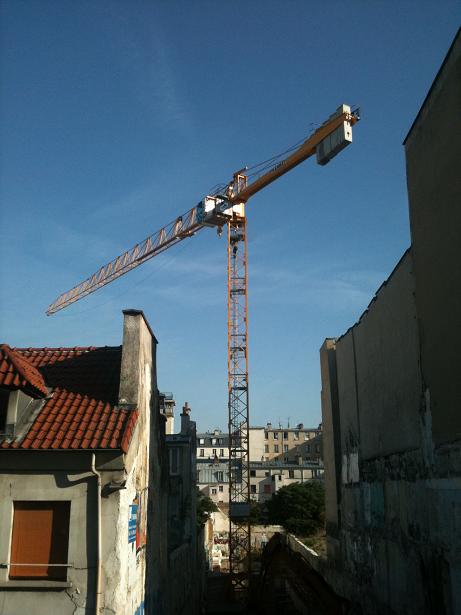
City Snapshots: The Loneliness of a Tower Crane Driver

Climbing up the ladder, there’s not so far to go. Towards the clouds, to my box in the sky, leaving my worries behind. Up here the city is in my control, its people a cast of tiny characters I can manipulate at will.

Lifting ten tonne logs like they were matchsticks, concrete panels like the pages of a book, I build this city from its ruins. I'm an eagle's eye and an elephant's trunk, with the grace of a dove and the force of a hurricane.

Some days I forget what my voice sounds like, swallowed by the twisting steel and radio crackles. The sky streaks in ever-changing colours around me, and clouds roll over my head, but I can never stop. I just keep turning my arm and building your dreams.

Day becomes night and there's only me left on site. Pinpricks of light appear across the world and the faces down below have all drifted away. Going back down to earth always seems so unnatural, but soon I'll have to descend. I'm standing on the precipice, but it's oh so far to fall.

Inspired of course by this song, and also by the ever-evolving film set in front of my window!

Saturday, 25 June 2011

Défense d'Afficher - again?

I previously wrote about the ubiquitous 'Defense d'afficher' signs that can be seen painted on municipal walls around France, but my attention was drawn recently to another variation on this message.

This one was a small white plaque screwed into a brick wall in a non-descript back street, but what particularly stood out was the date of the law. This was not the standard 1881 decree, but rather one that dated from 1943 and France's infamous Vichy regime.


As the scrawled message on the plaque says, this was indeed a 'loi Pétainiste' (or rather a 'loi Laval'), but what exactly is being forbidden here?

The message writer here has spotted the date, and looked to make comparisons between France's collaborist state during the Second World War and today's perceived authoritarian rulers, but in reality the law mentioned is rather banal. However, it is also one that had a big effect on the way French cities looked.

Look back at old photos of Paris and you will see advertising painted onto all visible wall surfaces. Some of these traces remain as so called 'ghost signs', but this law is in fact the edict that signed their death warrant. It was the first law in the country that seeked to protect the esthetics of the city from rampant advertising, limiting the publicity to a restrictive maximum size and height.

Two questions remain though. Whilst the world was at war, why was the Vichy regime worrying about city esthetics? Secondly, why is a law voted by this regime still applicable today?

The first question is very difficult to answer. It is unlikey that the law had anything to do with restricting the actions of the resistance, and is probably more a reflection of the lack of important decisions the puppet state had to make.

Concerning the second question, the answer is that many of the Vichy regime's voted laws were allowed to stand after the war. As soon as De Gaulle returned to France and assumed leadership of the country, the collaborationist government was declared null and void. However, in the interests of simplicity, only the laws relating to the war were immediately repealed. All other laws were examined by jurists and very often reissued with no modifications, including the addition of a 'Mother's Day' to the French calendar!
Twitter Instagram Write Bookmark this page More

 
Design by Free WordPress Themes | Bloggerized by Lasantha - Premium Blogger Themes | Premium Wordpress Themes