Louise Michel will be forever linked with Paris, la Commune and with revolutionary activities in general, but rarely is she connected to the suburban town of Levallois. However, it is here that she is buried and where her eponymous Metro station is situated. What are her connections with this town though and why did she choose to pass eternity here?
 It seems strange to find the grave of the country’s most famous female revolutionary in one of Paris’s most bourgeois suburbs. Surrounding her is incessant construction, the headquarter buildings of multinationals, the home of the French secret services and the highest number of security cameras in France. These steel and glass constructions though hide a town with a working class past, and one where Louise Michel felt very much at home.
And she has not been forgotten in the town. She is represented here today by a triptyque of symbols; the Metro station (on the street of the same name) and her tombstone of course, but also in the Parc de la Planchette where a small statue of her stands. Situated in a quiet corner it would be easy to miss, but once found it cannot fail to surprise. It is of an old lady with a cat at her ankles and her arm around an admirative young girl. Beneath, a simple message – Louise Michel 1830 – 1905. Without this label, few would make the link between this maternal image and the ‘vierge rouge’.
For the author Bertrand Tillier, this image of Louise Michel by the sculptor Emile Derré, is problematic. That there is a statue of the ‘red virgin’ in a town where she had many links is entirely normal, but why should it be this figure of an old lady with her revolutionary past behind her rather than something more challenging? However, for the Conseil Municipal who paid for the statue in 1910, it was for the assistance she gave to the poor of the town that she was remembered, rather than for her ideas which they 'didn't entirely share', and a consensual image was therefore chosen.
 We are rarely able to control our image after death, but it is probable that she would have cared little for this triviality anyway against the much larger issue of the continuing class struggle. Nevertheless, the way she is represented in the town today provides an interesting footnote to her story, as well as to the story of 20th century France in general.
Louise Michel's links to the town of Levallois were not founded on any particular love for the place, but rather because it was the place where her mother was buried before her. Louise Michel was someone who moved often, in struggle, in exile and through force, but Levallois provided her with a base for the final years of her life.
 When Louise Michel was born, her mother, Marianne Michel, was working as a serving-maid at the very austere Vroncourt Château in the east of France. The identity of her father is not clear, but most biographies point the finger at either the son of the châtelain, Laurent Demahis, or at the châtelain himself, Etienne Charles Demahis. Louise Michel was largely brought up by her grandparents, but the seeds of the class struggle had seemingly been sown into her from birth.
She trained as a school teacher and moved to Paris in 1856. The period of Louise Michel's life which followed this has been very well documented (both by herself and others), but my interest is in how she came to live in Levallois, and what this says about her personality and beliefs. Despite being brought up by her grandparents, Louise Michel remained close to her mother, later living with or close to her in various places in Paris. Indeed, during the Commune, Louise Michel gave herself up to the forces of order as they had captured her mother and were threatening to kill her. It seems appropriate therefore that it should be her mother, in 1885, who brought Levallois into this story.
At this time, Louise Michel was locked up inside the notorious Saint Lazare prison. She knew that her mother had been in poor health for a long time, but it that was clear now that Marianne Michel had only a few more weeks to live. Louise Michel asked to be temporarily freed so that she could visit her mother one more time, a request that was accepted, but she was not there when her mother died. She made a second request, this time to attend her mother's funeral - which would take place at the Levallois cemetery, but this time she was refused, a decision that lead to near riots at the event.
When Louise Michel was freed a year later, she immediately set up base in Levallois where the local authorities, admirative of the person and her struggles, had found her a small apartment. A plaque can still be seen today on the wall of this building at 85 Rue Victor Hugo. It is interesting to find this connection between the two personalities, as they had been friends, and some stories even say that Louise Michel bore Victor Hugo a daughter called Victorine. This remains apocryphal, but the letters that Louise Michel wrote to Hugo, as well as the poem, Viro Major, that Hugo wrote about Louise Michel recount much of their tale. When Louise Michel lived in this building though, the name of the street was the Route d'Asnières, and it would only take on the name of the author at a later date.
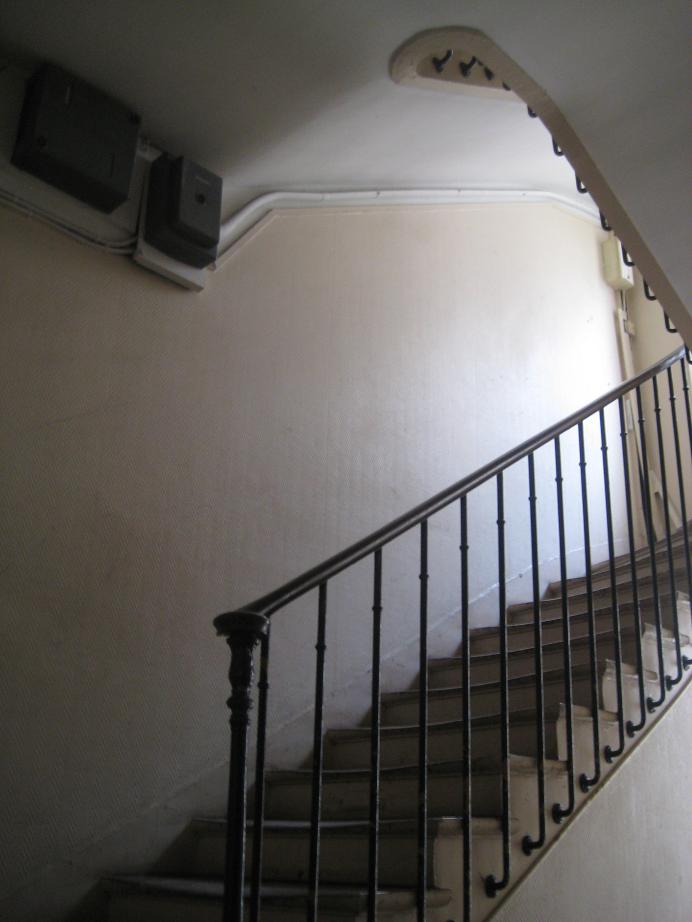 A staircase at n° 85 Rue Victor Hugo
 Louise Michel may have been comfortable at this address, very close to the cemetery, but her revolutionary activities did not end and within a few months she was back in prison. Over the next few years, Michel would be shot in the head, return to prison on several occasions and spend time in exile in London.
It is claimed that Louise Michel returned to Levallois to live on several occasions, but no address is given. What is certain though is that when she wrote her will, Levallois played an important role.
"Je soussignée, Louise Michel, déclare confier à Charlotte Vauvelle, ma compagne depuis 15 ans, et à mes camarades de lutte, pour les mettre à exécution mes dernières volontés, qui sont d'être enterrée sans aucune cérémonie religieuse (...) au cimetière de Levallois-Perret, dans le caveau de ma mère, où il y a une place pour moi" (I the undersigned Louise Michel, confide to Charlotte Vauvelle, my companion for 15 years, and my comrades in the struggle, the execution of my last wishes, which is to be buried without any religious ceremony, at the Levallois-Perret cemetery, in the vault of my mother where there is a place for me)
Louise Michel died in Marseille on January 9th 1905, and on the 21st, her body was transferred by train
to Paris. It arrived at the Gare de Lyon at 10 in the morning, and was transported to the Levallois-Perret cemetery followed by a massive procession of mourners. The last wish of Louise Michel was respected, and she was placed alongside her mother.The story though does not end there. Twenty years later, the municipal authorities in Levallois decided to change the name of one of the streets in the town to the Rue Louise Michel. This decision though was overturned by the regional authorities who stated that such tributes could only be made for "des personnalités décédées sur lesquelles l’Histoire a pu se prononcer" (dead figures for whom history has been able to make a judgement). In other words, the scars of the Commune had still not healed in Paris.
The street name was finally changed in 1946 (along with the Metro, from the previous Vallier), at a time when the authorities probably had more important subjects to think about. At the same moment, Louise Michel was also exhumed and moved to a more central, important position in the cemetery, the 'Rond-point des Victimes du devoir'. Her bust looks out proudly and defiantly from her new tomb, and there is always a red rose to keep her company
. But is that all there is?When I visit, I ask for the location of the tomb of her mother, the vault from which she was exhumed in 1946. I'm told that her mother is still with her today, but her name is not written anywhere on the stone. Louise Michel would have cared little for her personal idolisation, but never wanted to be separated from her mother. I hope that they are together somewhere in this town.