(Rue de Pontoise, 75005)
After declaring my love for brick on this blog, like an obsessed suitor I've now started to see it popping up all over the city. Along the Rue de Chateaudun a red chimney stack spine running up through the grey stone side of a building. Opposite, in a structure being rehabilitated, flashes of brick nudity on partially undressed walls. Walking aong one street though, I discover a fascinating trio of brick constructions which reveal much about the history of the material in Paris.
The Rue de Pontoise in Paris runs down to the Seine across the Boulevard St Germain from just adjacent to the Mutualite building. A rather insignificant street, it nevertheless offers several points of interest. The most well known structure in this passage is the Piscine Pontoise, a swimming pool designed by the architect Lucien Pollet in 1933. Whilst the brick façade is of a rather standard design, it is inside that the architect hid the jewells. Art deco tiling runs throughout the building, but what catches the eye most are the two balconies surrounding the pool, each offering individual changing units. This unusual structure gave a melancholic and slightly threatening backdrop to Kieslowski’s film "Bleu".
 Behind the Piscine Pontoise you can just catch glimpses of the newly renovated Collège des Bernardins, a medieval monastry and centre of learning. The spotlessly new terracotta tiles on the roof of this building give an attractive background to the Piscine, but what really catches my eye is this magnificent brick chimney, stretching up to catch the last rays of afternoon sun.
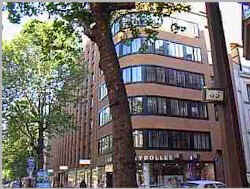
 Either side of the piscine are two more fascinating structures. On the corner of the Rue de Pontoise and the Boulevard St Germain, a building cut away from its bretheren and left to stand and guard this spot alone (see photo at the beginning of the post). From this angle, it gives a very curious perspective, appearing almost knife thin, but what interests me most is how it displays parts of the construction that were originally designed to be hidden away. Behind the classic Haussmannian façade we can now see the rear of the building and the rather shameful brick wall and bathroom windows. I’m not sure what would have originally hidden this view, but it feels almost voyeuristic to observe it today.
 Flanking the piscine on the other side, a more typical later use of brick, but this time in a most unusual design. From the early decades of the 20th century, brick was the material of choice for municipal buildings, and many schools appeared sporting this element. Typically, these structures were in art deco or more modernist forms, but the school in the Rue de Pontoise is in a decorative, italianate form. The building features many elements typical of this style, such as projecting, over-hanging eaves and arch-headed windows. Even the brickwork is more ornamental than is usual, incorporating a fresque, and a wide selection of coloured bricks, ranging from deep blues to delicate pinks. It is further evidence if evidence is needed of just how flexible and multi-functional this material is.
Note:
If you are interested in brick and find yourself in this area, two other structures should be of interest. Firstly, a fantastic and imposing ‘ilot’ building behind the Maubert Mutualité market on the Boulevard St Germain. Secondly, further along the Boulevard Saint-Germain at number 57, the Ecole Supérieure des Travaux Publics.


 How quickly our youth and young manhood disappears! Today music is streamed in bits and bytes. Slash and burn then return, listen to those notes churn. Do we know what true music sounds like anymore? Files are shared, but music is stuck in individual pods. We've entered a world where quality is less important than the number of titles we can carry around with us, and how easily we can skip and shuffle. Do we still believe that music can save our mortal soul? Here we are all in one place, a generation lost in My Space.
 Back to Rue Linné, and the sad sight of the four shops of the Jussieu music empire with the shutters down. What a waste! Once four proud horsemen, now a true apocalypse. It's the end of this world as we know it, and I don't really feel fine. It's coming like a ghost town, all the music shops have been closed down.


 A shoe or a key is a simple, universal object that has not changed to any great extent in centuries. Although we may now speak of biometric security, keys are still the keepers of the city door, and they still look much like they did in the middle ages. Our feet may be dressed today in more sporty models than in the past, but they are still functional items that have the same attributes as their ancestors - a heel, a sole, insoles and laces. When a lock changes or a heel breaks, we do not care about finding a modern, attractive store for our need, but someone who can offer us a quick service at a reasonable price.
 In many ways it is the ideal city business. Initial investment in tools and materials is low, and the shop can be set up in the smallest, low-rent units. It can be a one-person occupation with limited need for additional staff, and offers a steady stream of income with no need for continual occupational training. Storekeepers can keep stock for almost indefinite periods, and offer a service that people will never be able to reproduce in their own homes. For these reasons, it has often been a service provided by immigrants into a city, although with saturation levels reached many years ago in Paris, it is only through the purchase of existing units that the recent arrival can set up shop today.

 Like their sisters at the top of the street, neither of these buildings functions today according to the original intended purpose. Number 16 was recently ceded by the EDF electricity company to the city of Paris, and is currently home to an information centre on renewable energy forms, but is earmarked for further development, possibly into a sports centre. Number 11, with its more classical forms, has become offices.
 The early decades of the 20th century saw brick make a grand comeback in the city, but almost entirely on municipal buildings, particularly the swathes of social HBM housing around the edges of the city. In these more recent times though, brick has suffered on two fronts. Whilst it has largely been snubbed as a material by the rich since the 17th century, it also became deeply unfashionable in modernist circles. In the United Kingdom where brick has always reigned supreme, it became a class issue; being a material for the masses it was too lowly for the wealthy. It even became a 20th Century insult, with the term ‘Red-brick Universities’ given to the more modern schools, belittling them in comparison to the classical stone of Oxford and Cambridge.