Thursday, 9 February 2012

Move along, nothing to see here…

All cities have their secrets, and Paris is no exception. It has its secret places too, but these are not deep underground or hidden behind high walls. The best way to hide a building in a city it seems is to make it as banal as possible.

A police presence needs to be visible in a city, but what about the back end of the operation? Where do they stock equipment, make repairs, test new products and programme support software? The answer in Paris is at the Direction Opérationnelle des Services Techniques et Logistiques, and an obscure building in the 13th arrondissement.

Bizarrely, this building manages to be at once completely anonymous and clearly visible. Anonymous due to its lack of any coherent architectural style or decorative feature, but visible thanks to the tall aerials and masts perched high up on the building’s roof.

What occurs inside exactly is not entirely clear. Indeed, it's not entirely clear exactly how you get inside! The official address is 4 Rue Jules Breton, but there does not even seem to be a door at this address (apart from a rather large garage door). Walking around the perimeter of the building (either on foot, or virtually via Google maps) makes the access problem no clearer (although via Google you do get a sneaky view into a garage where several marked and unmarked police cars are parked). This is a structure closed to outsiders, with no mention of its purpose, and only a pair of French flags and a couple of security cameras show you that this is an official building.

So what does happen inside? A recruitment site gives a vague idea. This is a place where the police get their uniform and guns, where vehicles and communication tools are tested and repaired, but also a place where heavy machinery (helicopters, boats) can be supplied. Clearly it has a role to play in surveillance too, possibly from the rooftop rooms which must also offer fantastic views across the city. 

The insides of this building are destined to remain a mystery, but perhaps its better that way. We can imagine an Ali Baba's cave of technology, staffed by slightly eccentric Q clones, but the reality is probably a lot more ordinary. The outsides - cracked and grimy concrete - already seem to tell us that there is nothing to see here.

Friday, 3 February 2012

An 'Avertisseur de Police' - a forgotten relic?

This rather strange looking object, on the very limits of the city, is an ‘avertisseur de Police’. Before telephones were widely installed across Paris, these machines allowed witnesses to crimes or accidents to contact the nearest police station.

This news report published in the newspaper Le Soir in 1939 explains how they were used;
 
« D'un coup de coude énergique, M. Moreau, balayeur municipal, fit sauter la glace de l'avertisseur de police ; Allo, Police-Secours ?... Un cadavre dans un sac ! Ici devant le 88, boulevard de La Chapelle ! » (With a vigourous swing of his elbow, Mr Moreau, a city street cleaner, broke the glass on the police call box: ‘Hello Police? A body in a bag ! Here in front of 88 Boulevard de La Chapelle’)
 

Looking at the object, situated here on the Carrefour Bineau, just at the entrance to Neuilly sur Seine, it would seem that you broke the glass (long since gone here of course), pressed the button and communicated via the grills beneath and on the ides.

Why this particular avertisseur is still standing here is not clear, but strangley enough it is situated opposite another relic from the past - an Octroi tax building I previously mentioned on this blog. My guess therefore would be that it was left behind when city limits shifted, and that nobody since has wanted to take responsibility for its removal.

Now it remains as a picturesque reminder of a non-connected past which those under 25 will probably struggle to even imagine!

Sunday, 29 January 2012

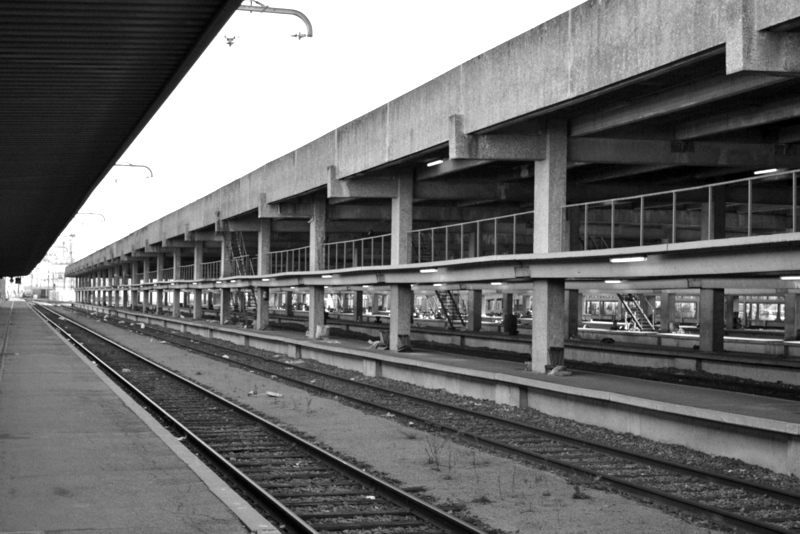
Brutal Bercy, the concrete coffin


On December 11th, a group of mayors from France's Auvergne region organised a protest in Paris against the transfer of their trains from the Gare de Lyon to the Gare de Bercy. Smartly dressed and wearing their stripes of office, the mayors were also carrying a coffin, a sign that - for them - this move represented a ‘burial’ for their region.

"Les Auvergnats sont déprimés de devoir arriver dans une gare qui ne procure aucun confort, aucun hôtel, on a l'impression d'être traités comme des gens arriérés, comme des ploucs" (the Auvergnats are depressed about having to arrive at a station without comfort or hotels, and we feel as if we are being treated like backward people, like hillbillies), said Claude Malhuret, the Mayor of Vichy. But is this train station really so bad?

What is true is that it is difficult to find. It is hidden away up on a plateau, with no direct links by Metro or bus. Access by foot is along a busy road, under a succession of dark and noisy railway bridges.

In reality, the station is simply an annex of the Gare de Lyon, built in the 1970s specifically for the 'auto-trains' service that ferries cars across the country. It replaced a simple goods station, where wine production from across France would arrive, before being stocked in the famous nearby Bercy 'chars'.


Arriving in front of the station, the lack of any distinctive design is immediately striking. There is no neo-classicism from the railway's golden age, only 1970s functional architecture. The ensemble is curiously colourless. Apart from the sparsely decorated Christmas tree in the car park, nothing justified the use of colour photography.

Inside it is the image of a small, provincial station. There is no buzz of arriving and departing trains, but rather small groups of drowsy and listless passengers. There are no shopping arcades to keep them amused, and they sit in rows, their eyes sweeping the room in search of a single decorative feature that they might focus on.

Above there is a second level - another rather sinister waiting room, with plastic chairs and plastic plants. A door offers access out to the car park, where vehicules wait before being loaded onto the car trains. A group of youths are sit broodingly on a wall, but whether they waiting for a train or for life to catch up with them is not clear.

For a brief time, perhaps the station's glory years, it had a touch of glamour. It was the Paris home of the night trains to and from Rome and Venice, trains that I took myself on several occasions. In the evenings, the station was filled with the multilingual agitation of international travellers. Early mornings, the same travellers arrived back in Paris, bleary eyed and fuzzy brained. This service ended last year, but a new one has now begun - departing from the Gare de Lyon of course.

All that is left - beyond a sprinkling of slow regional trains, is the auto-trains service. The thick slabs of dark, heavy concrete that make up the infrastructure give it a film-noir atmosphere, especially when it is empty. Indeed, it seems entirely natural to read that a member of the ETA Basque separatist movement was spotted by police here then trailed to his point of arrest.


Finally, what seems to typify this station is not disdain, but instead a heavy feeling of ennui. Rather than a burial, it is in reality more like being relegated to the second division, or losing your triple A rating. Renovations are promised soon, with - for the first time ever - real public transport links. Perhaps then it will finally be adopted as a home by somebody.

Tuesday, 24 January 2012

Le Déclin and a fall from grace

Flicking swiftly through hundreds of vintage Paris postcards at a fair recently, my finger was stopped dead by a singularly melancholic picture. Paris is a city that people boast of visiting, but here was a sculpture of two miserable looking figures entitled 'Le Déclin' (the decline), with behind them a thoroughly working-class city vista. Dating from the very beginning of the 20th century, it was as far as possible from the standard image of Paris, and therefore definitely worthy of investigation. 

Some information was given on the postcard, but several other mysteries remained. The sculpture was by the artist Clément Leopold Steiner, and was situated in the Square du Père Lachaise. The statue is not one that I had ever seen before, and I wasn't even sure where the Square du Père Lachaise was situated - understandable, given that it is today known as the Square Samuel de Champlain (a small park probably best known for being the site of Moreau-Vauthier's 'Le mur aux victimes des Révolutions').

Information on the motives and tastes of the postcard sender can often be found on the rear of the card, but here there was just a laconic 'bonjour'. Why was a postcard of this sculpture made, and why would anyone at the time choose to send such a picture to friends or family? The answer can perhaps be found in a brochure printed for the Societe national des beaux-arts exhibition at the Galerie des Machines on the Champ de Mars in 1898 where Steiner's sculpture was first presented.

"Le déclin, de Léopold Steiner, est bien, très bien. Ces deux vieillards simplement assis au soir de la vie, forment un groupe des plus remarquables dans la section de sculpture de la Société des Artistes français."
(Le déclin by Léopold Steiner, is good, very good. These two old people sitting simply in the twilight of their lives, make up a remarkable group in the sculpture section of the French artists' society.)

Clearly it was a sculpture that had artistic merit, and was of the tastes of the day. Sadly for Steiner, he didn't live to see a slow decline into graceful old age himself, and died in 1899 - the year after the presentation of the sculpture - aged only 46.

The sculpture was purchased by the city of Paris, and placed in a new garden directly opposite the Père Lachaise cemetery. The couple were perched at a height that enabled them to look directly over the wall and into a possible future place of rest (and away from the city of Paris), but whether this was a deliberate decision is not known!

The sculpture was seemingly quickly adopted by those in the vicinity of its new home, and looked at more closely it is easy to see why. The couple are not sad, but merely physically tired after a life of labour. They are obviously not wealthy, but contented that they have been able to grow old in each other's arms, something that would have been an aspiration for many people in this working class part of the city. It was positioned on the top of a series of steps, which people would sit on, as another charming postcard I found online shows.


In more recent times though, another mystery has arisen. By all accounts the sculpture was no longer standing in the garden, but where was it originally situated, and where is it now? The only way to find out was to visit the garden, postcard in hand, and investigate.

In my postcard, the only clue was the spire of the Notre Dame de la Croix church in Menilmontant, which is clearly visible in the background. All other visual clues have been demolished and replaced by taller buildings. Fortunately a more recent picture of the sculpture existed which gave me all the evidence I needed.

Somebody who had known the sculpture in better times was surprised and saddened to return to the garden around 15 years ago and find it painted and covered in grafitti. This photo was a rather sad and pathetic sight, but at least it showed me exactly where the sculpture had sat in the park.

 
In its place today is a rather spindly rose garden. Nearby is a bench, but the discarded cans of beer in the vicinity show that this is not somewhere that families come to relax, nor old couples in their twilight years.

The sculpture has therefore been removed, but where is it today and will it ever return or find a new home? To find out, I contacted the Marie du 20eme arrondissement who informed me that the statue had been removed in 2002 following a period of damage and deterioration. More importantly, they also told me that there were no plans to bring it back to the park. Today it sits - probably with many other damaged and discarded creations - in the city of Paris's art collection storage space in the suburb of Ivry. 

Looking at my postcard again I can see why else it attracted my attention. It's a simple image, but one that finally says much about Paris. The background is a city that has changed beyond recognition, but the picture also tells us about changing tastes and changing behaviours. It's a postcard with a story - albeit a rather unhappy one - and one worth saving from the dusty box of memories. 

Friday, 20 January 2012

An interview with Glynis Ridley, author of ‘The Discovery of Jeanne Baret’


I was recently sent a review copy of ‘The Discovery of Jeanne Baret’ by Glynis Ridley, a fascinating investigation of the life of the first woman to circumnavigate the globe. The story is made even more remarkable by the fact that Frenchwoman Jeanne Baret came from an impoverished rural background, and disguised herself as a man in order to join the global expedition.


Glynis Ridley’s investigation is not the first time this story has been told, but through a mixture of groundbreaking research and a certain amount of supposition, she has managed to flesh out Jeanne Baret’s life, and give her a more three-dimensional identity.

We discover a very determined woman, who through her intense knowledge of herbal medicine managed to transcend her roots, and eventually receive official acknowledgement from King Louis XIV. Ridley’s account though does not glamourise the tale, and instead details how Baret gave away her only child, suffered mistreatment from her partner, and was very possibly raped when her true identity was discovered.

Here I talk to Glynis Ridley about Jeanne Baret, and about the story behind her book.

Who, in just a few words, was Jeanne Baret?
She was a Frenchwoman of very humble origins, born in 1740, who, in her twenties, became the lover of one of France’s most celebrated botanists, and hatched an audacious plan to disguise herself as a man so that she could follow him to sea on the first French circumnavigation of the globe. Women weren’t allowed on board French naval ships at the time.
 

What originally attracted you to this story, and what did you feel you could bring to the tale?
The expedition commander, Louis-Antoine de Bougainville, wrote a 500 page bestselling account of the circumnavigation on his return. And he devotes only one paragraph to Baret, though she worked tirelessly in all weather conditions, from the Strait of Magellan to Tahiti, to try to maintain the charade that she was a man. We remember lots of explorers but few people have heard of Baret. This seemed wrong and I wanted to see if she could emerge from the historical shadows and be given some credit.

Glynis Ridley
Do you feel that your background as a Professor of Literature gave you more freedom to tell this story, in comparison to an historian who is tied by the obligation to rely solely on empirical evidence? Do you feel that this has brought you closer to the truth?
Oooh. Where to start with that question! Can I begin by challenging the assumption about historians and their reliance solely on empirical evidence? Historians disagree as much as any other group of researchers about what was a policy failure or success, and about historical cause and effect. One of my favorite historians is Simon Schama and in his marvelous book Dead Certainties he tackles the question of what historians can truly know and what they do. My book, The Discovery of Jeanne Baret, is non-fiction, and I’ve adhered to the same standards of proof as any history writer. My period of specialisation is the 18th century, so everything I say about literature of the time has to be grounded in a completely accurate historical context. Sometimes, in literature classes, professors will find students who think that they can just say a text means anything – I promise you and your readers this isn’t how literature professors conduct themselves – we have to have evidence in the material under consideration for everything we say. You can probably guess by now that this is something very dear to my heart and I could get into a long account of how ‘literature’ and ‘history’ are not that different really. But I think you get the idea.


The only known image of Jeanne Baret, with revolutionary cap.
The title of your book seems deliberately ambiguous. What is implied by this title?
It is deliberately ambiguous. It’s about what Jeanne Baret herself discovered – about the world, and it’s about her crewmates’ discovery of her true identity, but most of all I hope it is about the reader’s discovery of her.

You are sometimes very hard on Baret’s companion, Philibert Commerçon. What brought you to this conclusion about a man who also took enormous risks to his personal and professional reputation by smuggling a woman on board the ship?
I certainly didn’t set out with this as a deliberate strategy. There is much I find admirable about Commerson. He had a passion – for botany – and he chose to pursue that, even though it brought him into conflict with his father. He was smart, and could obviously be enormously good company (that’s why I included the information on how Commerson impressed Voltaire, because it proves that Commerson could be truly engaging when he chose). But I think I disagree that he took risks in smuggling Baret aboard ship. At no point did she implicate him in the scheme and, since he expressed himself as surprised as anyone by the revelation of her true identity, and since no one on the expedition had any means of investigating Baret’s and Commerson’s life together before the expedition, all he had to do was insist he was innocent of any subterfuge and no one had any way of disproving this. Put crudely, Commerson was not an obvious target for physical assault in the way that Baret was. And had he wanted to make her both comfortable and respectable (in terms of the morals of the day) he would have legitimized their relationship by marrying her.

How easy or difficult was it to research this story, and to find new information? What was your most satisfying find?
It would actually be possible to write a whole bookshelf’s worth of non-fiction (or fiction!) about the Bougainville expedition, given all the journals that survive. The most difficult thing for me was making sure I was progressing the story, while simultaneously providing enough context for readers to understand the hierarchy of life aboard ship, or the status of women in the natural sciences, while also trying to keep the focus on what things must have been like from Baret’s perspective. My most satisfying find was undoubtedly MS884 in the Commerson archive in the Museum national d’histoire naturelle. It is the ‘Tables des plantes medicamenteuses’ – the list of medicinal plants, that I assign to Baret for the very first time.  Realising that this notebook contains precisely the sort of folk wisdom about the healing properties of plants that herbwomen kept a closely guarded secret was one of those amazing moments researchers dream about. I thought, “this is Baret’s notebook”. 

What mysteries remain from Jeanne Baret’s life? What information do you wish you could have found?
On the cover of The Discovery of Jeanne Baret, readers will see the only known image of her. But as I point out in the book, the image is something of an oddity because she is wearing what came to be known as the red liberty cap of the French revolutionaries, and she is dressed in a striped fabric that those who research the history of clothes can tell was not popular with sailors until the 1790s. When I was writing the book, I chanced to go around the Ashmolean Museum in Oxford and I saw an illustration of the first curator of the Oxford botanical garden, Jacob Bobart, represented holding a sheaf in his hand – just like Baret is in the illustration. The caption of the Bobart illustration at the Ashmolean said that such poesies were a symbolic shorthand for the medicinal value of a botanical garden. So whoever produced the mysterious illustration of Baret wanted to link her with the French revolution, the sea, and the healing power of plants. They knew more about her than any printed source at the time could have told them. I’d love to understand the French Revolutionary connection.

What do you think is Jeanne Baret’s legacy?
Since the book came out, University of Cincinnati botanist Eric Tepe has kindly named a new species of Solanum (the genus that includes potatoes and tomatoes) in her honor: Solanum baretiae. This is the first time in nearly 250 years that a plant name has been published in honor of Baret. I think that if learning her story inspires more research into the history of neglected historical figures, that would be marvelous – especially if those individuals have been written out of history because they weren’t from the class of history writers. If her story inspires just one person to think that the seemingly impossible may in fact be possible, then that would be quite something. And on a personal level, after completing the biography, I try to grumble less about days when I get cold and wet, because no one is asking me to go and clamber about on the shores of the Strait of Magellan in bitter cold, knowing that tomorrow will probably be more of the same. Baret endured so much. I think her story is inspiring.

Click here to purchase ‘The Discovery of Jeanne Baret’ by Glynis Ridley if you are in the US, here if you are in the UK, and here in France.

For more information, and further discussions, visit Glynis Ridley's author site on Facebook: www.facebook.com/authorglynisridley
Twitter Instagram Write Bookmark this page More

 
Design by Free WordPress Themes | Bloggerized by Lasantha - Premium Blogger Themes | Premium Wordpress Themes