Thursday, 15 November 2012

Invisible Paris on CNN

At the end of October I was filmed by a team from CNN for a travel show on Paris. Considering the standing of the other guest presenters involved, it was an honour to be included, and an all-round interesting experience.

One thing I quickly learned was that television is not a natural medium for me! With this blog I have become accustomed to writing at length about sometimes tiny details, but this is simply not an option with such a visual medium. 

>>You can watch the film here (I’m after Frenchie chef Gregory Marchand).<<

My brief had been to present three places that have significance or importance for me, but as I was representing my blog it was quite a challenge to choose these places. My blog focuses on the invisible, but here the necessity was to select places that would be interesting visually for the camera. Secondly, this was a travel show, so the chosen spots should be places that people might theoretically want to visit and see for themselves.

I finally decided to have three places that could be linked by a theme, with this being the edges of the pre-1860 Paris. I would talk about the villages – Belleville, Charonne and Gentilly (including the Bièvre river) – that were annexed into Paris, and what traces they have left in today’s city.

That was the theory anyway. Despite preparing myself a script, on the day of shooting the realities of filming became apparent. The angle of the sun made one shot impractical, cars constantly interrupted recording on another, and at the third the owner of a café told us that he didn’t want his establishment being filmed. As this last place – on the corner of a grafitti-filled street – is not at all my favourite bar in the city, I was quite happy to move on to another spot.

With all this, and with shots being recorded several times from different angles, my train of thought got a little bit lost. At the end of the day’s shooting, I wasn’t even sure what I had actually said anymore, and that was before CNN did the editing.

Looking at the result, I think it looks great. The CNN Go city series is genuinely interesting (albeit very fast moving), and I thoroughly recommend their guides to other cities. Even in Paris, the eclectic choice of guest presenters (a chef, a designer, a DJ, a musician, a tattoo artist…and an English blogger!) is quite audacious for such a mainstream channel, and shows a city far from traditional tourist guides.

However, it is also quite frustrating to see that many filmed segments didn’t make the final cut, elements that I think would have made my presentation clearer and more complete. For this reason, I have put the script I wrote online here. You can just imagine how it may have looked on screen, and perhaps I’ll one day try to film these parts again!


I would like to thank Lidz-Ama, France and cameraman Sylvain for choosing me, and for their efficiency and good humour which made me feel very at ease - despite being filmed for ‘a potential audience of 300 million people’!

Sunday, 11 November 2012

The Way of Saint James through Paris and beyond


For many people a trip to Paris is a kind of modern-day pilgrimage, but for several hundred years the city has also been one of the traditional starting points on the Chemin de Saint Jacques (Way of Saint James) pilgrimage to Santiago de Compostela in Spain.

The pilgrimage, an activity common to most religions, uses the act of walking as a means to obtain moral or spiritual redemption. It is walking with a purpose following emotionally significant paths, and therefore
curiously similar to the very secular psychogeography of the Situationists. I decided to combine both by taking a drift along the historical route through Paris, using the scallop, the symbol of the Saint Jacques/ James pilgrimage, as my guide.

The Tour Saint Jacques
Although many pilgrims come from further north, stopping perhaps at the Basilica of Saint Denis and the Saint-Jacques-Saint-Christophe church alongside the basin de la Villette, the traditional starting point for pilgrimages from Paris was the Saint-Jacques-de-la-Boucherie church, of which only the tour Saint-Jacques remains.

The rest of the church was taken apart after the French revolution, with the individual stones sold off and used for other constructions. It is ironic that a building that stands now almost as a monument to the French secular society should still be the starting point of religious pilgrimage. That said, many of the 'pilgrims' who follow the route today do so for their own metaphorical reasons, or just for the pleasure of walking.

From this point it is around 2,000km to Santiago de Compostela, a distance that serious walkers can expect to cover in around six to seven weeks. My walk to just beyond the city limits would take around two hours.

Saint Julien le Pauvre
Setting off from the Tour Saint Jacques in Chatelet, the first stop is just across the river, at the Saint Julien le Pauvre church. Outside, the oldest tree in Paris. Inside, my first scallop, a holy water font, just inside the entrance.

The church is something of a mongrel. It is one of the oldest remaining religious sites in the city, but the building is made up of mismatched bits added or altered throughout its history. Like Saint-Jacques-de-la-Boucherie, it was listed for demolition during the revolution then forgotten about before being given over to the city's Melkite community at the end of the 19th century.  

As is the case with the majority of churches in Paris, this one was almost entirely empty. A couple of musicians were setting up their equipment for a concert that would take place later that evening (the only time when the churches are full), and provided an interesting sonic soundscape to the visit. On the noticeboard, a message encouraging me to purchase a candle for 10 Euros, with the money going - appropriately enough - towards a future pilgrimage of young parishioners to Santiago de Compostela. 

The Musée de Cluny
The route towards Santiago de Compostela from Paris most clearly begins on the significantly-named Rue Saint Jacques. Dating back to roman times, it is perhaps the oldest road in Paris - and was also one of the busiest until Haussmann hacked out the much larger and noisier Boulevard Saint Michel alongside. 

A few steps away from Rue Saint Jacques is the Musée de Cluny.

This medieval mansion house, originally the residence of the Bishops of Cluny in Paris, is in flamboyant gothic style, and a gaudy demonstration of wealth. Although the house was not on the pilgrim's route, the influential bishops of Cluny played a key role in the mapping of the various paths, and it is perhaps for this reason that exterior walls of the house are covered in scallops. Interestingly, 19th century pictures show a house without these shells, suggesting that they were a much later addition (after the house had become a museum), a kind of fake gothic ornamentation to attract gullible pilgrims passing by.

Saint Jacques du Haut Pas
Further along the Rue Saint Jacques, just beyond the Pantheon, a sign high up on the wall of a building, tells us that we are passing through the old Porte Saint Jacques, one of the entrances into Philippe Auguste's walled city. A few hundred metres to the south is the next significant site, Saint Jacques du Haut Pas.

On the wall outside, another scallop symbol, this time confirming that the church stands on the Chemin de Saint Jacques.

Inside the church, which was originally built in the 12th century on land belonging to an order of monks from Altopascio (Haut Pas) in Italy, there is another scallop holy water font. I also meet Saint Jacques/James himself for the first time.  

The diminutive statue dates from the 14th century, his face and hands eaten away by time, but there is surprising power in his delicately carved features.

Inside the church I spot a man with a backpack, walking boots and cut-off denim shorts, the only person I see that day that matches my idea of a pilgrim. As I leave the church I spot him again, striding purposefully in the direction of Santiago de Compostela.

Random traces
I'm disappointed not to find any shops selling tacky trinkets (or scallop shells), cashing in on their position along the route in Paris, but it's probably too early in the trip for that. However, I do though see scallops on the menu of several restaurants. 

Near the Val de Grace hospital, I find a real scallop shell, stuck somehow to a concrete wall. Quite high up (I need to stand on a wall to photograph it, drawing strange looks from passers by) it also blends in to its background, making it difficult to spot. As a route marker for pilgrims, it seems rather clandestine. On the other side of the road, at the entrance to the hospital's chapel, a giant scallop shell fans out behind the head of a statue.


The city limits
As I approach the edge of the city the significant sites start to thin out. The Rue Saint Jacques becomes the Rue du Faubourg Saint Jacques, informing us that we are moving away from Paris. To the left, the high walls of the Santé prison then the Saint Jacques Metro station, both situated almost exactly at the point where the pilgrimage route cuts across the Paris meridian

As Saint Jacques becomes the Rue de la Tombe Issoire, the path becomes less clear. There are no scallop markers plotting the route, so I continue walking in a straight line. After passing by the giant - but hidden - reservoir de la Vanne, I see that this decision was a mistake.

Somewhat incredibly, the path seems to lead straight onto the périphérique motorway. The final stretch of road is a non-space, a collection of trees and bushes beside the Cité Universitaire, housing a small tent city of the homeless. The street seems to serve no purpose, beyond acting as a shortcut known only to taxi drivers.

On the other side of the périphérique I can see that the road continues in a straight line. Was the centuries old pilgrim's path redirected when the motorway was built? 

Continuing beyond Paris
It seems that the correct route today is to veer off onto the Rue du Père Corentin which leads down to the chaotic Porte d'Orléans. Beyond Paris the route spans out in two directions, towards Orleans or towards Chartres. Just outside the city though I make one final stop, at the surprising Saint Jacques le Majeur church in Montrouge.

Although churches have stood on this spot since the 13th century, this impressive concrete box dates from the 1930s. Designed by the architect Eric Bagge, it was built with the assistance of the engineer Eugène Freyssinet, and is very reminiscent of his industrial hangars. 

If the building looks like it is missing something, this is because construction was interrupted by the war. A spire was planned, but finally never added. The building is in quite poor condition today, and was apparently closed (for the afternoon? The day? For repairs?), but I was happy nevertheless to spot a series of scallops in the stained-glass windows.

My trip finished here, as has many other people's over the last hundred years or so. In 1885, the bishop of Paris declared that this church (in its previous conception) was one of three in the Paris region that people could make a pilgrimage to if they were not capable of walking all the way to Santiago de Compostela. Today that's good enough for me.

Next stop: Bordeaux
My walk covered around 5 kilometres. From here it would be just another 1,995km to Santiago de Compostela, but instead we'll take a leap of over 500km and pick up the path again in Le Bouscat, just to the north of Bordeaux.

Part Two: Invisible Bordeaux then picks up the trail again as it winds its way through the city of Bordeaux.

Monday, 5 November 2012

The Paris Archives: A Lucky Find?

With an exhibition on the later works of the artist Raphael currently running at the Louvre, it is interesting to note an earlier link between the renaissance painter and Paris.

An article published in the Petit Parisien newspaper on Feb 2nd, 1899 describes a disagreement between a secondhand goods trader and an art dealer - with a picture by Raphael at the heart of their discussion!

The adventure began when the art dealer went in search of a wooden frame with very specific measurements. He found exactly what he was looking for in the secondhand goods trader's shop, and purchased the frame - which still contained a very dusty and mouldy painting - for the very minimal sum of 20 francs.

A few days later, a painter (the article is very short on names and specifics!) visited the art dealer's shop and spotted the frame and painting. After clearing away some of the dust and grime from the picture, he declared it to be a creation by Raphael that had some link to his Adam and Eve painting that hangs in the Vatican.

Raphael's Adam and Eve

After the painting was cleaned up and restored it was eventually sold to a collector for 80,000 francs. A very healthy profit for the dealer, but also seemingly a very cheap price for a Raphael (by my estimations, 80,000 francs in 1899 is the equivilent of around 300,000 Euros today).

Naturally the story didn't end there. The secondhand trader got wind of the sale and immediately went to the dealer to ask for the money he had received for the painting. The dealer refused, claiming that the picture had come free with the frame. Given the impasse, the disagreement was taken to the law courts for deliberation, but here the article ends and I can find no further trace of this case.

Was this a genuine Raphael, and if so how did it get to Paris and into such a sad state, and where is the painting today? Who eventually profited from the lucky find? If anyone has any answers please don't hesitate to let me know!

Thursday, 1 November 2012

The First Skyscraper in Paris

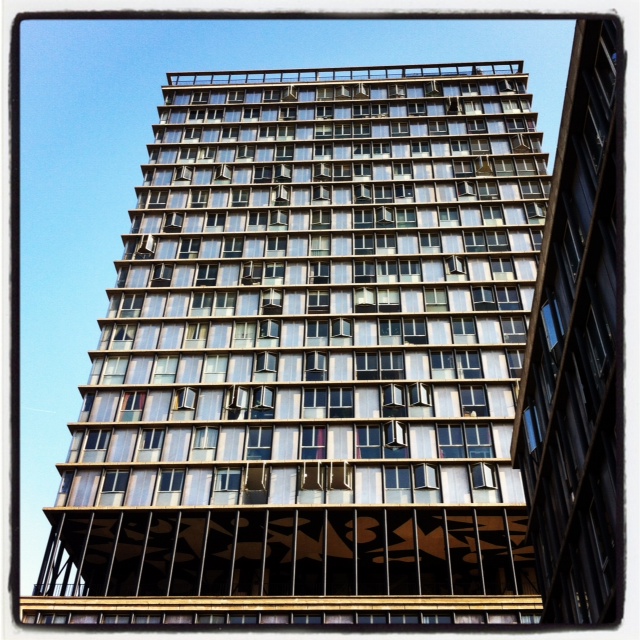
The subject of tall buildings in Paris is still a controversial one, but it is easy to overlook the fact that the first skyscraper was erected in the city over 50 years ago. This particular structure, variously known as the Tour Albert or Tour Croulebarbe, is even a protected historical monument today.

By international standards, the Tour Albert (for the sake of this article we'll use this name as it connects it to Edouard Albert - its principal architect - rather than the area in which it can be found), is a tiddler. At 67 metres and 23 floors it is not even a third of the height of the Tour Montparnasse, but in its time it was just as revolutionary.

Although its size, breaking age-old city regulations, was obviously controversial when it was completed in 1960, the revolution was mostly in the way the building was put together (by the engineer Jean-Louis Sarf). The tower is almost a completely pre-fabricated structure, using a system of concrete filled steel tubes interspersed with horizontal blocks of concrete. Having almost no internal supporting walls, the apartments can be freely reorganised according to the desires of their inhabitants.


This design, combined with its facade of glass and stainless steel panels and the fact that all windows can be opened outwards gives it an almost unique aspect. Perhaps most interesting of all though is the terrace that cuts through the building about one third of the way up.  

Seen from below, it is the cubist-styled decorations by artist Jacques Lagrange on the ceiling of the terrace that stand out. This space though is not just a simple design feature of the building, but was originally planned to be one of its key elements. To appreciate this, we need to see the building from the other side, on the Rue Abel-Hovelacque.

The view from this angle is obscured by a tall iron fence, but by standing on tip-toes and pointing the camera over the top, it is possible to see that the building sits above an RATP Metro depot. 


The original sketches by the team of architects (Édouard Albert, Robert Boileau and Jacques Henri-Labourdette) shows how they had imagined the construction. Despite being the first 'skyscraper' in the city, it is in fact an extremely discreet building and largely unnoticeable in the city landscape. This is because it is built into a slope, with the terrace marking the point where the land drops sharply downwards.

The architects had planned to cover over the Metro depot and create an esplanade in front of the building. The terrace would have been a viewing platform, open to the general public (indeed, visible in the sketches are the Eiffel tower and what looks like the dome of the Invalides building, although both are now obscured in my photo by other buildings).

An interesting article published in the Liberation newspaper in 1995, shortly after the building had been granted listed status, gives us an even greater insight into this atypical structure. 

The article describes promotional material for the new construction that appeared in the le Figaro newspaper on 23 January 1959. The slogan for prospective buyers was 'aimeriez-vous habiter au premier étage de la tour Eiffel?' (would you like to live on the first floor of the Eiffel tower), but the reference was not the one that the building's principal architect would have chosen. Edouard Albert was a fan of gothic architecture, and deliberately chose to model the height of his tower on those of Notre Dame (his tower measures 67 metres, against 69 metres for Notre Dame).

It seems that the building's modern design appealed to young professionals, including a large number of university professors, who were attracted to the building due to its proximity to their schools and comparatively cheap prices. Situated in what was historically a working class part of the city, it quickly became known as the 'Tour des Snobs'.

If the building was listed in the inventaire supplémentaire des monuments historiques in 1994 it was largely down to the campaigning of the architect's daughter, Anne Coutine, who has also lived in the building for a number of years. "My father would have hated the fact that his building had been listed" she explains,  "but I had to do it to stop it falling into ruin."

After being listed, it was renovated in 2005 by Gorka Piqueras, and now looks ready to stand for many more years to come.

Friday, 26 October 2012

The Trinquet de la Cavalerie


On a curve of the Rue de la Cavalerie, not far from the Ecole Militaire and Eiffel tower, stands a rather grandiose art deco car park. Even more impressive than its exterior though is the fact that tucked away on its 6th floor is an unexpected Basque pelota trinquet.

Looking above the ground floor it is difficult to imagine that this 1920s building is a car park, but in many ways this is no ordinary structure - and indeed no ordinary car park. Bring your eyes down to ground level and you'll see that alongside the entrance is an Aston Martin garage! 

My interest though is in a discreet doorway to the left which leads - via a small and creaking elevator - to the 6th floor and a terrace that offers views across the neighbouring rooftops towards the Eiffel tower.


I had been invited here to discover an unsuspected and seemingly secret world, the Club de Pelote Basque de Paris, for a tour of the establishment, an explanation of its history - and a chance to play the game myself!

One thing is immediately obvious - this is a place that was designed as a gentlemen's (sporting) club. Although the building itself sports the clean lines of the art deco movement, the interior of this club is rather stuffy (or cosy), with a predominance of wood and ochre coloured walls. It is easy to imagine members in previous times puffing away here on cigars, the smoke drifting upwards, slowly deepening the tones of the walls and ceilings.


Although the sport itself is ancient in origin, and today based roughly on the French jeu de paume, this particular trinquet - as well as the tennis court alongside and a (now closed) restaurant above - were built by an Argentinian. The facilities were for the Club de Pelote Basque de Paris, founded in 1929 by the same man - the country's ambassador to France, and many of the original fixtures and fittings remain.

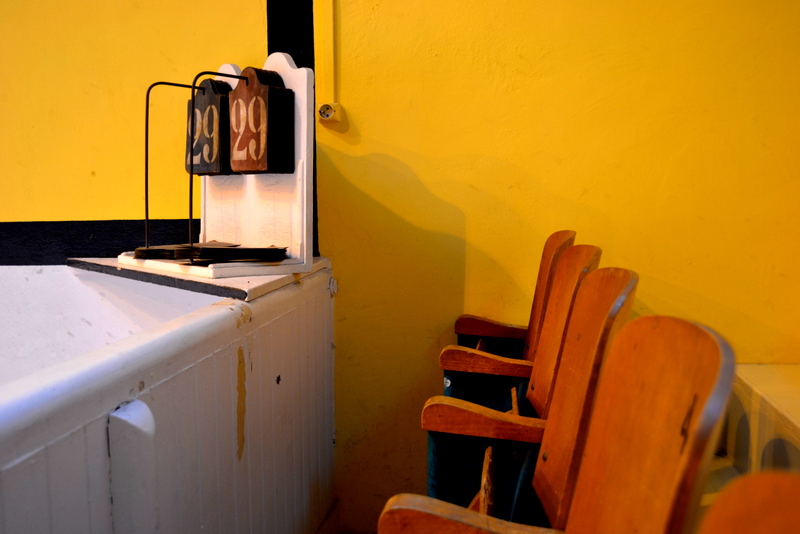
Taking up most of the space is the fronton, the court where the game is played, but surrounding this are seating areas for spectators, a small bar and a lounge area. The space has become multi-purpose, offering a centre for other activities for the Basque community, including a choir.


Highlighting the 'gentlemen's club' origins of this trinquet is the fact that it only has one changing room. Even today though this does not provide any major problems as there is currently only one female member at the club!

This is not to say that there is a policy of exclusion here - far from it. The members are all very friendly, taking time to explain the rules, demonstrate the game and lead us through a practice session.


The game is fast, exciting, even rather primitive. The top players are ambidextrous, swapping the paleta bat easily from hand to hand, flicking their wrists to add spin and to search for tight angles. When I play though, it is all about just hitting the ball as hard as possible to make sure it reaches the front wall, a sensation that takes me back to schoolyard games from my childhood.

Sitting watching the game, it is interesting to take note of the surroundings. Almost everything is in wood - the ceiling above the fronton, the seats, the lockers in the changing rooms, the fittings in the lounge and corridors - and clearly most of it dates back to the 1920s. It gives the place an organic feel, the wood slightly battered and humid to the touch, an odour of perspiration in the air from over 80 years of intense physical activity.


It is tempting to imagine using the place as a local club, but annual subscriptions cost upwards of €1200 (although they are cheaper for younger members and students). These prices though are not designed to exclude, but are rather a simple necessity to ensure the survival of the club. The club pays a high rent, and although the building and its interiors are protected, the facility does not yet have listed-status to ensure that it can only ever be used for Basque Pelota in the future.

Although club membership is probably only for those truly passionate about the sport, the members did tell me that visitors are welcome to come and watch games or have a drink at the bar. The whole facility can also be rented out in the evenings if you have a special event to organise!

Thanks to the CPBP for the invitation and initiation, and to happycurious for organising the event. Similar initiation sessions will shortly be organised as part of Mastercard's Priceless Paris programme.
Twitter Instagram Write Bookmark this page More

 
Design by Free WordPress Themes | Bloggerized by Lasantha - Premium Blogger Themes | Premium Wordpress Themes