In a letter sent to newspaper 'Le Temps' in February 1887, a group of artists, writers and architects criticised the soon to be built Eiffel tower, calling it "inutile et monstrueuse". Gustave Eiffel, an engineer and a "constructeur de machines", would be scarring the beautiful face of the city in an attack on generations of artistic creation. Were these cultural leaders aware though that just three years previously, Eiffel and his company had designed and built a collection of artists' studios in the west of the city?Situated on the Rue Aumont-Thiéville near the Porte Maillot, this set of studios was built in 1884 using a new method for this kind of construction. The building is divided into six workshops each spanning an identical width, and the overall metal framework was made in Eiffel's Levallois factory. As these were standardised modules, they could be built at a lower cost and in a very short time. The rationality and simplicity of this architecture is closer to industrial buildings of the time, and in some ways anticipates the current fashion for artists to install themselves in converted factories and workshops.

 The 1880s were a golden age for such constructions in Paris, but few artists' studios looked this way. The majority would have been far more pleasing to the artists who signed the letter criticising Eiffel, as they were built according to classical or neo-gothic designs. However, few have aged as well as Eiffel's, and several were even torn down before the dawning of the 20th century.
 What is the role for such studios in today's city though? Artists are traditionally 'penniless', and such spaces as these would clearly be expensive to rent in Paris. It is no surprise therefore to see design agencies and osteopaths installed in some of the units, but one or two artists still seem to be using the facilities.

Finally, although this construction may have shocked or surprised when built, it has over time been surrounded by even more modern buildings. Reflected in the windows are some of constructions built by ed architectes (including their offices) in the 1970s. It's certainly not a style I appreciate, but I'm not sure I'd write a letter to a newspaper criticising it. Who knows what styles will survive the test of time?


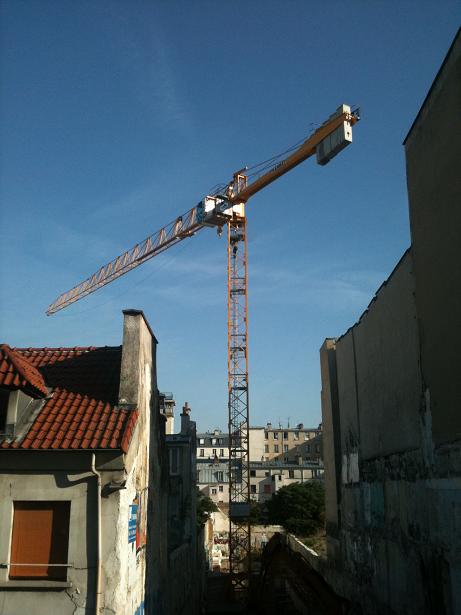 Climbing up the ladder, there’s not so far to go. Towards the clouds, to my box in the sky, leaving my worries behind. Up here the city is in my control, its people a cast of tiny characters I can manipulate at will.
  Some days I forget what my voice sounds like, swallowed by the twisting steel and radio crackles. The sky streaks in ever-changing colours around me, and clouds roll over my head, but I can never stop. I just keep turning my arm and building your dreams.
  Inspired of course by this song, and also by the ever-evolving film set in front of my window!