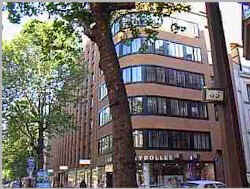
Walking along the Rue Jeanne d'Arc in the 13th arrondissement it would be easy to pass by a genuine piece of social history without noticing anything exceptional. At number 45, directly opposite the quaint and attractive houses of the Villa Auguste Blanqui, stands the first social housing project built in the city, a collection of small apartments which were paid for by a man of fortune to house the unfortunate.
A plaque on the front of the building shows that it was run by an organisation called the Societé Philanthropique (who still manage the building today), and the city of Paris have helpfully put a sign in the street outside giving an outline of the story, but what is most striking about the structure is the rough brickwork of the facade. This is social housing at its most basic, clean and functional accommodation, but devoid of any decorative features that may have encouraged the poor to stay a little too long.
 It was a rich banker named Michel Heine who paid for this construction through his Fondation Heine charity. He donated 600,000 Francs to the Societé Philanthropique and asked them to build a home for the 'deserving poor'. This was very much the philosophy of the Societé Philanthropique who believed (and apparently still believe) in helping the poor to help themselves, funding projects that help people get through difficult moments, to rebuild lives, or simply where the old could see out the rest of their days in dignity.
  Michel Heine was an interesting man, somebody who spent many years in the USA and married into the Richelieu dynasty (he was eventually buried in the family tomb). He knew and gave financial support to Sarah Bernhardt, calling her his 'cochon doré' (golden pig!). Heine's reaction to the building he financed is not documented, but it is possible that it was severe enough to ensure that no such buildings were put up again. Later constructions managed by the Societé Philanthropique all contained decorative elements, and it is suspected that the rich benefactors who paid for them did not want to be associated with such basic, functional structures. After all, it was their names which were often featured at the entrance.
For more details on this building, see my post on Bricks in Paris.


 Behind the Piscine Pontoise you can just catch glimpses of the newly renovated
  Either side of the piscine are two more fascinating structures. On the corner of the Rue de Pontoise and the Boulevard St Germain, a building cut away from its bretheren and left to stand and guard this spot alone (see photo at the beginning of the post). From this angle, it gives a very curious perspective, appearing almost knife thin, but what interests me most is how it displays parts of the construction that were originally designed to be hidden away. Behind the classic Haussmannian façade we can now see the rear of the building and the rather shameful brick wall and bathroom windows. I’m not sure what would have originally hidden this view, but it feels almost voyeuristic to observe it today.
 Flanking the piscine on the other side, a more typical later use of brick, but this time in a most unusual design. From the early decades of the 20th century, brick was the material of choice for municipal buildings, and many schools appeared sporting this element. Typically, these structures were in art deco or more modernist forms, but the school in the Rue de Pontoise is in a decorative, italianate form. The building features many elements typical of this style, such as projecting, over-hanging eaves and arch-headed windows. Even the brickwork is more ornamental than is usual, incorporating a fresque, and a wide selection of coloured bricks, ranging from deep blues to delicate pinks. It is further evidence if evidence is needed of just how flexible and multi-functional this material is.
 Like their sisters at the top of the street, neither of these buildings functions today according to the original intended purpose. Number 16 was recently ceded by the EDF electricity company to the city of Paris, and is currently home to an information centre on renewable energy forms, but is earmarked for further development, possibly into a sports centre. Number 11, with its more classical forms, has become offices.
 The early decades of the 20th century saw brick make a grand comeback in the city, but almost entirely on municipal buildings, particularly the swathes of social HBM housing around the edges of the city. In these more recent times though, brick has suffered on two fronts. Whilst it has largely been snubbed as a material by the rich since the 17th century, it also became deeply unfashionable in modernist circles. In the United Kingdom where brick has always reigned supreme, it became a class issue; being a material for the masses it was too lowly for the wealthy. It even became a 20th Century insult, with the term ‘Red-brick Universities’ given to the more modern schools, belittling them in comparison to the classical stone of Oxford and Cambridge.