Sunday, 13 September 2009

Journées du Patrimoine: My Recommendations

Next weekend sees the annual 'heritage days' in France when many secretive institutions throw their doors wide open to the curious eyes of the public. Well, this is the official line, but in reality it often seems to be simply a choice between waiting for hours to visit an official building or just having the opportunity to visit a museum without paying for once. However, it would be a shame to view it this way as there are several places that are offering something unique next weekend. Here is my selection, including several buildings that I have already previously mentioned on Invisible Paris. This is your chance (and mine!) to see them more closely:

Maison d'Auguste Comte
Auguste Comte's house is kept as a museum, but it is generally only open for two hours each week, and that at a time when I'm working! Weekend openings are very rare, so here is an opportunity to view the unchanged apartment of the philosopher/sociologist. You can also view his library and several of his manuscripts, and at certain times during the weekend there will be guided tours. If you want to know more about Comte, click on the link above.

10, Rue Monsieur le Prince - 75006 Paris
Saturday-Sunday 10h-13h and 14h-17h


Chapelle Notre-Dame-de-Consolation - Mémorial du Bazar de la Charité

Built on the spot of a terrible fire that cost the lives of over 150 members of the aristocracy (with around 95% of the victims being female), this chapel is always open to the public daily. What is more rarely seen though is the memorial section at the rear which explains the tragedy in more detail and celebrates the lives of the victims.

Rue Jean-Goujon, 75008
Saturday - Sunday 14:00 to 17:30

Hôpital Saint-Louis
Being one of the oldest in Paris and similar in style to the Place des Vosges, the hospital itself is always worthy of a visit. However, the true rarity this weekend is the opening of the famous Musée des moulages dermatologiques (Museum of dermatological masks) to the general public. It is one of the most secretive museums in Paris and is certainly not suitable for everybody, but if you have any interest in the subject the time to visit is now as it is generally only ever open for pre-arranged visits and then only to professionals or students in the subject. What is displayed in the museum? Several hundred moulds made from the faces of patients suffering from all possible skin diseases, created over one hundred years ago.

1 Avenue Claude-Vellefaux, 75010
Sunday from 14:00 to 18:00

Hôpital Salpetrière

Another hospital and another interesting event. I have written several times about this hospital and its links with the Charcot family, but normally it is Jean-Martin Charcot the father and neurologist to whom it is most closely associated. However, in an interesting twist for this weekend, the Charcot library (the collection of the father, given to the hospital by the son) will present several articles and archive documents on the time Jean-Baptiste Charcot (the son) spent at the hospital before changing tack and becoming a world-famous sailor and explorer. It will be an almost unique opportunity to see such information, but it should be noted that the hospital, particularly the chapel, is also a fascinating visit in itself.

91, Boulevard de l'Hôpital, 75013
Saturday, 10:30 to 17:00

Palais d'Iéna
Auguste Perret is an architect who fascinates me, and I previously wrote about him in connection with his design for the Mobilier National building. For the Journées du Patrimoine, it is his most well-known and well-respected building that will be open, the wonderful Palais d'Iéna. Following classical, academical principles, it is nevertheless resolutely modernist in design.
Once again, this is a rare opportunity to visit a building that is today used by the French Economic and Social Council.

9, Place d'Iéna - 75016 Paris
Saturday - Sunday, from 10:00 to 17:00

Moulin Rouge
This is not a place that I would normally recommend visiting to anybody, but I can't deny that it is a historical institution. It's difficult to resist the idea of visiting the private salons and backstage areas and wandering around amongst the costumes without being asked to pay 30 Euros for a glass of champagne. This is the first time it has ever been opened to the public for this event, so expect large queues!

82, Boulevard de Clichy, 75018
Saturday - Sunday, from 09:00 to 15:00


Siège du Parti communiste français

It has become something of a tradition for me to visit Oscar Niemeyer's fantastic 'siège du Parti Communiste' each year during this event. Living close by, I often see it from the exterior, but it is the interiors that are really worth investigating, particularly the space-age underground auditorium!

2, Place du Colonel-Fabien - 75019 Paris
Saturday - Sunday from 10:00 to 17:30

Friday, 11 September 2009

Killing Time

Le Musée de la Prefecture de Police
As light necessarily brings shadow, so it must follow that the city of light should also have its dark side. Behind the Paris illuminations, a small museum takes visitors to this côte obscure, guiding them through some of the more sombre chapters in the city’s history, with photos and recreations of executions, poisonings and massacres. If you have a strong stomach, let me take you on a guided tour!


The Musée de la Prefecture de Police is probably the most difficult museum to locate in the city. X marks the spot on the map, but following the instructions leads to a building that looks like it belongs in Stalinist USSR. From the outside you would be hard pressed to find a single clue that would signal that there is a museum inside, but fortunately when you are lost here you can always ask a Policeman.

A uniformed arm points towards a temporary staircase that sends you clanking through the scaffolding on the outside of the building and suddenly you find yourself alone inside a working Police station. A piece of paper on a notice board says ‘Musée 2eme étage’, but nothing or no-one is around to stop you from setting off and exploring the entire building. The corridors are dimly lit, and echo with the dull banging of hidden construction sites, whilst the staircases unnervingly feature the staring faces of the 167 policemen who were killed during the liberation of Paris. Scampering up the stairs, it is relief to see the mounted sign that announces the entrance to the museum.

A large notice points out that photography is not permitted, so you will have to make do with just my words on this visit. The museum is apparently 100 years old this year, but in reality it looks more like something that was put together in the 1960s or 70s. There is a selection of moth-bitten costumed models, exhibits described by fading typewritten notes and not a whiff of multimedia in sight. This though all adds to its charm!

Unless you are fascinated by uniform and medals you can probably skip the first part of the exhibition. At their origins in the 17th century the police were little more than groups of militia, nicely dressed but with few responsibilities (their mission was resumed in three words: “netteté, clarté, sûreté”), and necessarily little of interest concerned them in this period. The story warmed up during the French Revolution when groups of people spontaneously organised themselves into a makeshift police force, but there was still no official service until the 19th century when the “Sergents de ville” were created in 1829.

The first item of interest is a reconstruction of Giuseppe Fieschi’s “Machine infernale”, a kind of homemade machine gun with two dozen or so barrels that the Corsican used in an attempt on the life of the Roi Louis-Philippe on July 28th 1835. Louis-Philippe survived but 18 others were killed in the incident. Fieschi himself was severely wounded by his own machine, and was saved from death purely so that he could later be tried and executed!


"Tête de Giuseppe Fieschi après son exécution" – Raymond Brascassat, 1836 (Musée Carnavalet, Paris)

Later in the 19th century comes a page in the history of the city that the museum quickly turns over. In many respects, the museum, run by the Police and largely about the Police, finds itself in a tricky position. How can an organisation that has been implicated in some of the greatest crimes during the period covered by this museum present itself in a fair-minded way? Many questions are simply swept under the dusty rugs, and that is certainly the case with the massacres that marked the ending of the 1871 Commune uprising. Indeed, the impression one gets is more of the police as victims, with a large painting showing the burning down of their headquarters earlier on in the uprising.

At the end of the 19th century, photography began to become an important aspect of police work and the museum gets more interesting! A photo-montage highlights the actions of a group of anarchists who terrorised the city in the 1890s, leading us into the most important room in the museum; crime and criminals in the 20th century. This long room hosts a series of glass cases organised by individual crimes. Often there is the original murder weapon with dubious stains and gruesome archive photos, and details on how the crime was solved. It’s a procession of ten inch spikes, serrated knives and crushed skulls!

The museum finishes with documents relating to the Second World War. Once more a very tricky subject for the Police, an organisation that was absorbed into the machine of the Nazi occupiers. A small display shows how members of the police force were responsible for the persecution of Jewish members of the community and for the rounding up of many of these people, but again here the focus is more on the policeman as victim. Larger cases and the photos that line the staircases highlight the individuals who fought for the resistance or who died during the liberation of the city, but how many of these had also been involved in the crimes against innocents beforehand?


Arriving at the end of the visit, this leaves a slightly bitter taste in the mouth. The police play a key role in the life of any city, but in the city’s darkest moments, the role of the police has not always been to bring back light. It’s a relief to leave the building and see the sun again, but since I have discovered the museum, morbid fascination urges me back from time to time to taste the dark side once more.

Monday, 7 September 2009

Paris Polaroids: An Afternoon Spent in 1968

For the first in a new series of Paris Polaroids guest posts, Tim Pike remembers his brush with the 1960s and his unique perspective on a Paris film set.

In 2002 I was mid-way through a two-year tenure at an organisation based on Avenue de Messine, just a stone’s – or, as we will soon find out, a cobblestone’s – throw from Parc Monceau in the 8th arrondissement.

Avenue de Messine has all the hallmarks of Haussmann’s Paris: it is a wide, tree-lined boulevard flanked by elegant but somewhat identikit buildings that mix and match residential dwellings with office space. It also happens to lack the hustle, bustle and vibrancy of the city’s more high-profile arteries. Automobile traffic there is always sparse, giving drivers the extra impetus to put their foot down and make the occasional pedestrian crossings potentially lethal for anyone who has the misfortune to be on foot. And it was Avenue de Messine that was momentarily closed to all-comers to form the backdrop to the May 1968 riot scenes in Bernardo Bertolucci’s movie The Dreamers, which were filmed there on a quiet August day and August night in, yes, 2002.

Granted, there’s nothing particularly novel about being in Paris and spotting a film being made. However, enjoying an office-window view of the clock being turned back 34 years in the space of an afternoon was a fascinating experience. The lone cars to have ignored the A4 warnings displayed on lampposts were towed away. Benches were uprooted and replaced with older models, as were the ornate metal grids that sit around the base of tree-trunks across the city. Parking meters were hidden. A 2002-vintage bank was boarded up and airbrushed out of reality. Then a procession of vintage Citroëns, Renaults and Peugeots arrived, driven by their proud owners. And finally, the pièce de résistance: thousands of possibly hand-crafted polystyrene cobblestones were tipped out onto the street by a delivery van, ready to be hurled at the police/authorities by the student demonstrators.

Meanwhile the main cast-members were hard at work in a nearby building filming some interior scenes, and outside a small army of extras reported to a desk which had been set up on the pavement. They were allocated their 1968 clothing, had their 21st-century hairstyles coiffed out of them and went to sit, smoke and drink coffee on makeshift seating a little further down the avenue, biding time until they were to be called on to riot against the Establishment.

Observing the people, artefacts and surroundings as they were sucked into the past, the colour scheme changed from bright, vibrant shades to a palette of browns, off-whites, greys and blacks. Suddenly the summer sun didn’t seem to be shining quite as brightly. But strangely, in much the same way as a black and white photograph puts greater emphasis on shadow and light, giving whole new dimensions to the subject matter, Avenue de Messine also instantly gained in character and personality; for once, there was a bit of life about the street.

My working day drew to a close as the cameras and crew relocated outside for the night-time riot scenes. I reluctantly left the office and my second-floor vantage point, whilst reminding myself that one thing the film didn’t need was a character wearing 2002 dress staring down from an office window. Walking past the piles of cobblestones, I pedantically wondered whether their airborne trajectory would be anything like that of their rock-solid counterparts, but reckoned researchers in white coats had probably already looked into the issue and that it was probably long-solved.

Returning to work the next day, just about every trace of it having been 1968 for a few hours had been scraped, moved or driven away. 2002 was back out in force and Avenue de Messine once again became its succession of interchangeable buildings and drivers in a hurry. I made a mental note to go and see the film when it came out but never did, so sadly I have never witnessed the end-product. Writing about it now though, I’m beginning to wish I had, if only to see how convincing those polystyrene cobblestones actually looked on the silver screen.

Tim Pike
Outside of his day job, Tim is also a talented musician and songwriter. He can be found at http://www.myspace.com/drbrochet and will also be playing a concert at the La Tactique bar on rue Pascal, in the 5th arrondissement of Paris on Friday September the 18th.

Send Your Paris Polaroid! The beauty of the Polaroid was that it captured an instant. Such pictures were celebrations of the emotion of a moment, but like memories, Polaroids faded over time. In this series I am aiming to compile a selection of these Paris instants for posterity. If you have a memory of a Paris instant you would like to share, please send it to me and I will publish it here. A photo (which I will transform into Polaroid form) would be a bonus but is not a necessity (I can find one!). If you have a site, a project or a business to promote, send me the link and I will add a mention to your post!

Sunday, 6 September 2009

Windows on the World

Three windows bring a reflection of the city in quick fragments. The first, in four quarters, panes of glass that cannot be looked through but which now act as a support for a simple creation. Painted white to hide what is happening on the other side, all I can see are these joyous characters. Strangely, I found these three females on an old building at the extremity of the Hôpital St Louis.

Further along, raindrops sliding down the dusty window of a telephone booth, draw my attention to a message hastily stuck inside. A week ago I mourned the forthcoming death of this simple piece of street furniture, but here it seems that somebody has found a novel use for the structure. This is not a request though, a lost dog or a person for hire, but...a recipe! This simple act of altruism reminds me of the BookCrossing book sharing initiative, and its nice to think of a city where people leave a trail of their favourite books or recipes behind themselves (click on the photo for a full list of ingredients and instructions!).

Back home, a view from my window. The wasteland opposite my flat is still just an empty space, and has become almost an unofficial park for street artists. Looking outside, I quickly snap this amusing game of perspectives. The artist and the passer by are both oblivious to each other, divided by a corrugated metal fence, but from above I can see both. I was impressed by how the artist manipulated the brush on such a long extended pole, but am not sure what the final message represents. Interestingly, it spelled out 17H51, almost exactly the time he finished painting, but he could not have known that before he began...could he?

Thursday, 3 September 2009

Unaligned

An invisible line runs down the centre of Paris and through the Observatoire in the 14th arrondissement, marking the point zero of France. Beaten to the prestige of being the centre of the world by the Greenwich meridian in London, it has left Paris feeling slightly askew. A fraction off of this line, overlooking the Observatoire, is a curious anomaly in itself – a building which never knew what time to set its foot in, and which stands as a monument to a similarly unaligned individual.

What makes us different from the others? A child often craves similarity and hopes not to stand out from classmates, but if an accident or illness strikes and leaves lasting traces, the child knows that they must adapt to a world where they will always be seen as a kink in that safe line of normality. How the child deals with this determines the route their life will take.

Xavier Haas was born in Paris in 1907 to hotel owning parents. Two sisters quickly followed and life was idyllic until illness struck Haas when he was only 6 years old. He had contracted Poliomyelitis when on a trip to Alsace, and soon realised that he would be condemned to a life of health problems and physical suffering. A year after this incident, the First World War broke out and the father was sent off to battle. He would survive – just – but would never be the same afterwards having been gassed in the trenches.


The house where Haas was born with the construction his parents had built behind.

Amidst this suffering, Haas discovered art. His Uncle, a talented but depressive artist, lived on the ground floor of his building and the young boy would often spend time with him. Haas had problems walking but he decided that he would excel with his hands, and become an illustrator, sculptor and engraver. After his education in Paris, he spent much time in Brittany where he struck up a lifelong friendship with another artist, Xavier de Langlais.

A portrait of Haas by his friend Xavier de Langlais.

The parents of Xavier Haas supported him in his chosen career and decided to construct a building that would enable him both to work and give him a steady income. It would also prove to be his lasting monument in Paris. The construction at 12 Rue Cassini was entrusted to the architect Charles Abella* in 1930, and the result is a curious but fascinating mixture of forms and styles, completed by an extraordinary sculptured frieze by Xavier Haas himself.

The building was designed as a place where artists could live and work, and was built alongside the house where Haas had been born. It is seven stories high, with bay-window fronted studios and an incredible twisting tower of Babel staircase. It is a building that is very much caught on the cusp of modernism (in its forms and the fact that the functions are so clear) and the neo-classical (Abella chose a kind of pebbledash stone exterior rather than bare concrete), and certainly stands out from other structures in the vicinity.

Haas took a studio in the building and added the frieze at the entrance. For one who was so physically weakened, the creation is a muscular show of force and a robust celebration of art. The art deco styled figures - solid, winged deities - and the extravagant swirls and decorations make it a very powerful work.

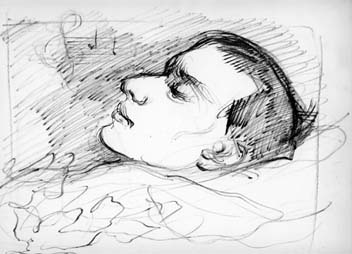
Haas would create other works, notably in Brittany, but his influence would be felt more in other areas. He was behind the setting up of an organisation known as the Paralysés de France, and contributed to their magazine called ‘Faire Face’. He continued creating, but ill-health would catch up with him and he died in 1950 aged only 43. His friend, de Langlais, who had often painted portraits of him during his life, sketched him as he lay on his deathbed. It is a quickly scratched picture of calm repose, but Haas would probably want to be remembered more for something else - the vigour of his remarkable sculpture which ensured that he would always stand out from the crowd.

*Charles Abella was not a prolific architect and only designed two buildings in Paris (the other is another similarly curious mix of styles on the Avenue Hoch). However, his name is associated today with one of the most prestigious architectural competitions in France – the Grand Prix d'Architecture de l'Académie des Beaux-Arts. The first prize is known as the Prix Charles Abella, and is awarded to promising young architects.
Twitter Instagram Write Bookmark this page More

 
Design by Free WordPress Themes | Bloggerized by Lasantha - Premium Blogger Themes | Premium Wordpress Themes